Bootstrap Breakpoints Responsive
Intro
Accepting in consideration all of the realizable display sizes where our website pages could eventually present it is important to design them in a manner offering universal sharp and powerful visual appeal-- normally working with the assistance of a effective responsive framework like probably the most popular one-- the Bootstrap framework in which most current version is now 4 alpha 6. But what it actually does to assist the pages pop up fantastic on any sort of display-- let us take a look and notice.
The major idea in Bootstrap ordinarily is adding certain system in the limitless feasible gadget display screen sizes (or viewports) placing them into a handful of variations and styling/rearranging the content as needed. These are also termed grid tiers or display scales and have evolved quite a bit throughout the different editions of probably the most prominent lately responsive framework around-- Bootstrap 4. ( click this)
The way to work with the Bootstrap Breakpoints Css:
Commonly the media queries get identified with the following format
@media ( ~screen size condition ~) ~ styling rules to get applied if the condition is met ~min-width: 768pxmin-width: 768pxDifferences of Bootstrap editions
In Bootstrap 4 compared with its predecessor there are 5 screen sizes however given that the current alpha 6 build-- simply 4 media query groups-- we'll get back to this in just a sec. As you most likely know a
.row.col -Display sizings
The screen dimensions in Bootstrap typically utilize the
min-widthExtra small – widths under 576px –This screen actually doesn't have a media query but the styling for it rather gets applied as a common rules getting overwritten by the queries for the widths above. What's also new in Bootstrap 4 alpha 6 is it actually doesn't use any size infix – so the column layout classes for this screen size get defined like
col-6Extra small-- sizes less than 576px-- This display certainly doesn't come with a media query however the styling for it rather gets applied just as a standard regulations being overwritten by the queries for the widths above. What is really likewise new in Bootstrap 4 alpha 6 is it certainly does not operate any kind of size infix-- so the column format classes for this particular display dimension get identified such as
col-6Small screens-- works with
@media (min-width: 576px) ...-sm-.col-sm-6Medium displays-- uses
@media (min-width: 768px) ...-md-.col-md-6Large displays - works with
@media (min-width: 992px) ...-lg-And at last-- extra-large display screens -
@media (min-width: 1200px) ...-xl-Responsive breakpoints
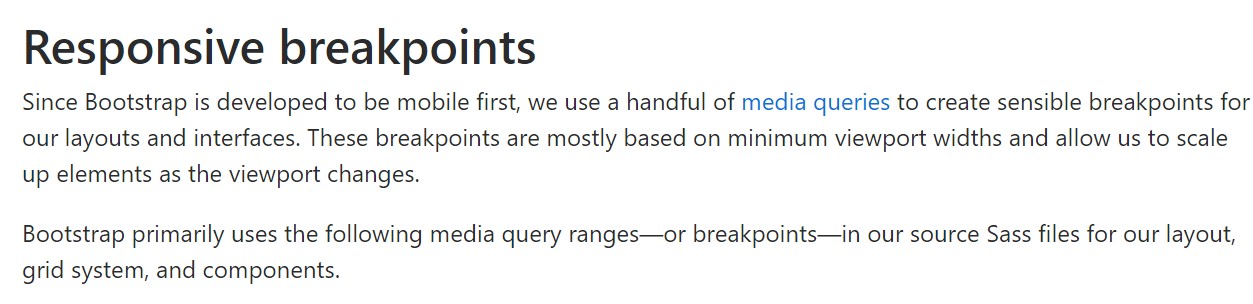
Given that Bootstrap is really built to become mobile first, we use a number of media queries to generate sensible breakpoints for designs and softwares . These particular Bootstrap Breakpoints Css are typically depended on minimum viewport widths and also make it possible for us to graduate up factors when the viewport changes. ( get more information)
Bootstrap primarily uses the following media query stretches-- or breakpoints-- in source Sass documents for format, grid program, and components.
// Extra small devices (portrait phones, less than 576px)
// No media query since this is the default in Bootstrap

// Small devices (landscape phones, 576px and up)
@media (min-width: 576px)  ...

// Medium devices (tablets, 768px and up)
@media (min-width: 768px)  ...

// Large devices (desktops, 992px and up)
@media (min-width: 992px)  ...

// Extra large devices (large desktops, 1200px and up)
@media (min-width: 1200px)  ...
Since we compose resource CSS in Sass, each media queries are actually accessible by means of Sass mixins:
@include media-breakpoint-up(xs)  ...
@include media-breakpoint-up(sm)  ...
@include media-breakpoint-up(md)  ...
@include media-breakpoint-up(lg)  ...
@include media-breakpoint-up(xl)  ...

// Example usage:
@include media-breakpoint-up(sm)
  .some-class
    display: block;
We in some instances use media queries that move in the additional course (the given display dimension or even smaller sized):
// Extra small devices (portrait phones, less than 576px)
@media (max-width: 575px)  ...

// Small devices (landscape phones, less than 768px)
@media (max-width: 767px)  ...

// Medium devices (tablets, less than 992px)
@media (max-width: 991px)  ...

// Large devices (desktops, less than 1200px)
@media (max-width: 1199px)  ...

// Extra large devices (large desktops)
// No media query since the extra-large breakpoint has no upper bound on its width
Once more, these kinds of media queries are in addition provided by means of Sass mixins:
@include media-breakpoint-down(xs)  ...
@include media-breakpoint-down(sm)  ...
@include media-breakpoint-down(md)  ...
@include media-breakpoint-down(lg)  ...
There are in addition media queries and mixins for aim a specific segment of display screen dimensions employing the minimum and highest Bootstrap Breakpoints Working sizes.
// Extra small devices (portrait phones, less than 576px)
@media (max-width: 575px)  ...

// Small devices (landscape phones, 576px and up)
@media (min-width: 576px) and (max-width: 767px)  ...

// Medium devices (tablets, 768px and up)
@media (min-width: 768px) and (max-width: 991px)  ...

// Large devices (desktops, 992px and up)
@media (min-width: 992px) and (max-width: 1199px)  ...

// Extra large devices (large desktops, 1200px and up)
@media (min-width: 1200px)  ...
These particular media queries are also readily available via Sass mixins:
@include media-breakpoint-only(xs)  ...
@include media-breakpoint-only(sm)  ...
@include media-breakpoint-only(md)  ...
@include media-breakpoint-only(lg)  ...
@include media-breakpoint-only(xl)  ...
Also, media queries may cover numerous breakpoint widths:
// Example
// Apply styles starting from medium devices and up to extra large devices
@media (min-width: 768px) and (max-width: 1199px)  ...
<code/>

The Sass mixin for  aim at the  equivalent  display screen  dimension  variety would be:

<code>
@include media-breakpoint-between(md, xl)  ...
Final thoughts
In addition to identifying the size of the webpage's components the media queries happen all over the Bootstrap framework commonly getting specified by means of it
- ~screen size ~Take a look at a couple of on-line video guide regarding Bootstrap breakpoints:
Connected topics:
Bootstrap breakpoints formal documentation
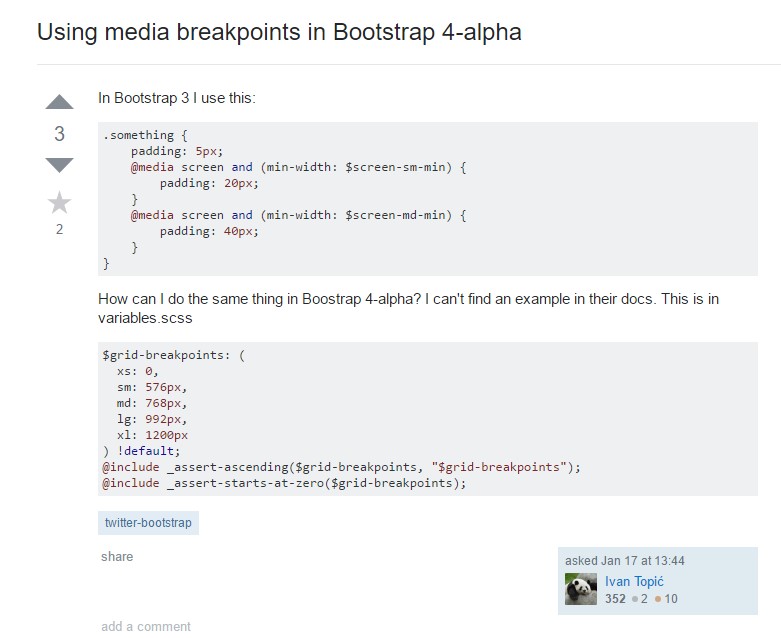
Bootstrap Breakpoints complication
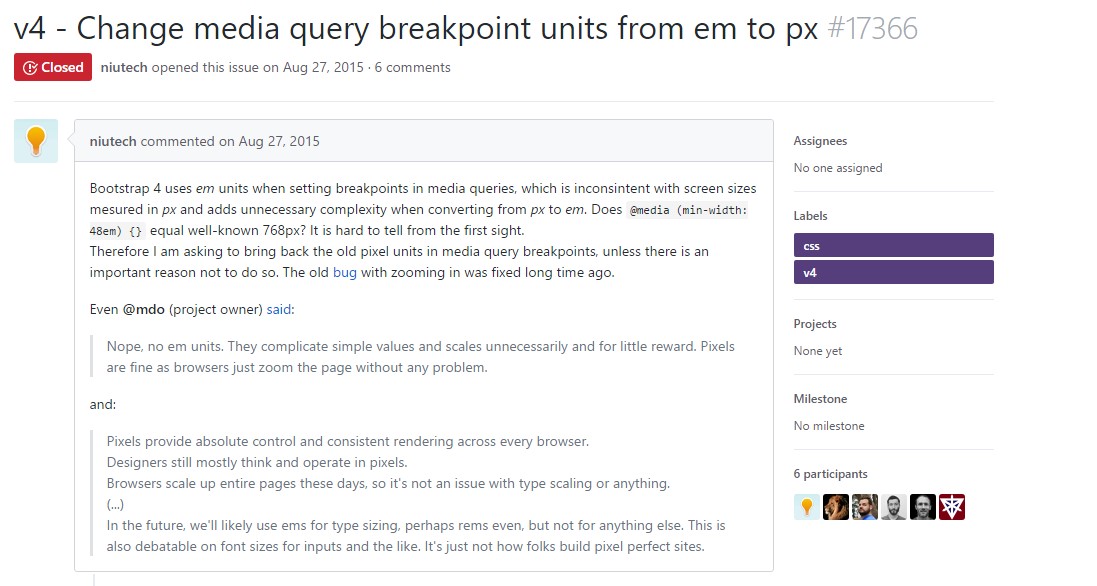
Modify media query breakpoint units from 'em' to 'px'